Babyrev
tl;dr
Simple flag encryption
Analysis
We get given a ELF binary called babyrev. As always, we first try to run it and see the initial behavior:
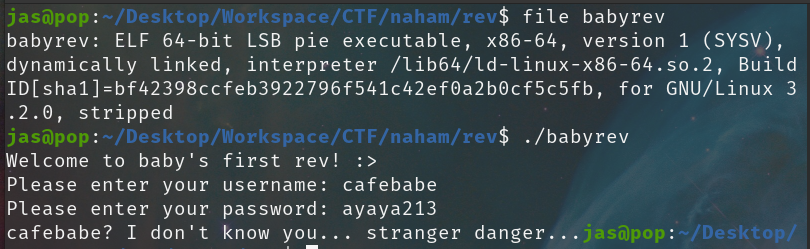
Seems like it asks for a username and password. Let's not waste time guessing and jump straight into static analysis with IDA.
Reversing the User Name
We load the binary in IDA and take a look at the main function:
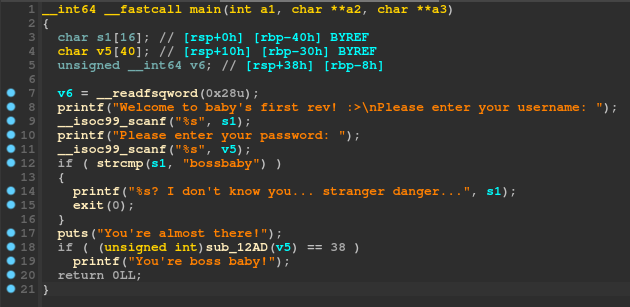
We can instantly spot the first check here:
if
;
Since s1 is read as the username, we can understand that the program requires the username to be bossbaby, or else it will fail and exit.
However, it doesn't end there. The program will then do another check with the following function:
if
;
So we would like that function to return 38? in order to win. Let's take a look at the function itself:
Reversing the Password
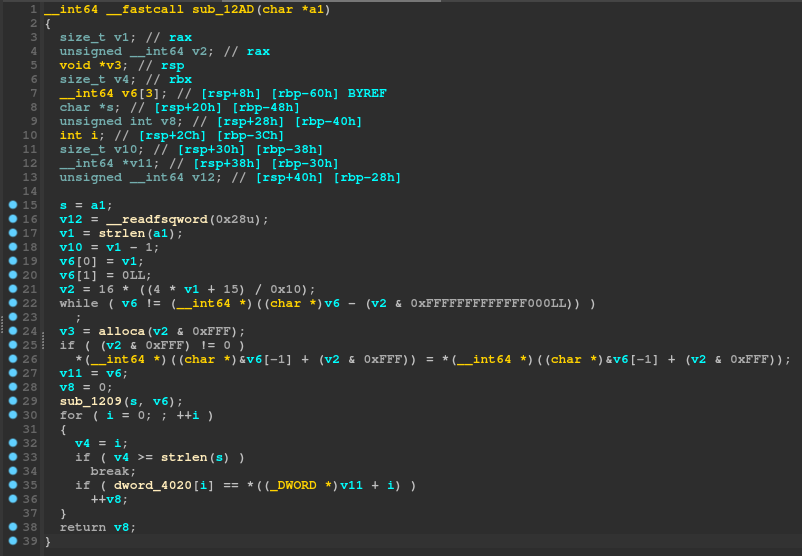
Remember that this function had v5 as an argument in main, which was the password that was scanned here:
;
;
That means that a1 will be the password buffer inside the context of this function as it is it's only argument:
__int64 __fastcall Initially when solving this I ignored most of the stuff in this function as it seems to be pointless. For example, looking at:
if
* = *;
This looks like a useless bit of code, so naturally I will ignore this and come back later only if I am stuck. The actually important part of this function is the following:
;
for
return v8;
A bunch of stuff happens here. In detail:
- Function
sub_1209is called withsandv6as arguments. If we look at the start of the current function, we can see thats = a1, sosis our password input. So some kind of function is ran on our password, let's keep this in mind and check later. - We iterate starting from 0 till
strlen(s)(or the length of our input password) and advance a variable called v8 ifdword_4020[i] == *((DWORD *)v11 + i). However, what isdword_4020andv11?dword_4020is a global array of some weird bytes and we can see it by double clicking on it: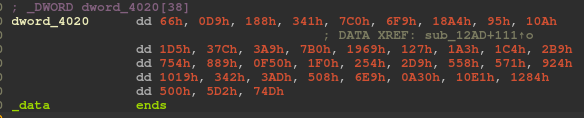
v11is set above asv11 = v6, but v6 is actually set in thesub_1209function that we haven't looked at yet
Tip
When looking at something like *((_DWORD *)v11 + i) in IDA, this could be translated to v11[i], if and only if v11 is a array of DWORDS.
This is as when you cast a pointer to a "pointer to some sized variable" in C, the compiler will assume any following offseting (for example, ptr + 0, ptr + 1, etc) as: ptr + offset * sizeof(element), where element is the size of the type we casted it as.
So if we cast v11 to a DWORD*, it basically means:
*(v11 + i * sizeof(DWORD))
i = 0: *(v11 + 0) = v11[0]
i = 1: *(v11 + 4) = v11[1]
i = 2: *(v11 + 8) = v11[2]
...
IDA doesn't actually know what the array is made for, and thus will most of the times produce these weird casts. If you are sure that this is a DWORD array, you can select the variable and hit Y, which will bring up the change type window. You can then change the type to what you think it is:

Which will then make it look a lot more normal:
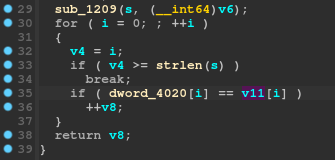
Reversing the Password
Continuing where we left off, it is now pretty clear that each byte of the global dword_4020 array is compared to each byte of the v11 array. Let's look at the sub_1209 function:
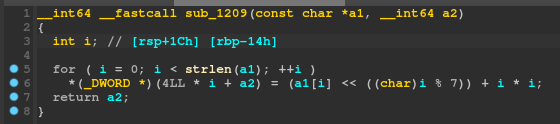
Hmmm, *(_DWORD *)(4LL * i + a2) doesn't seem right, let's use our new ✨reconstructing✨ skills we learnt above to turn this into a DWORD array:
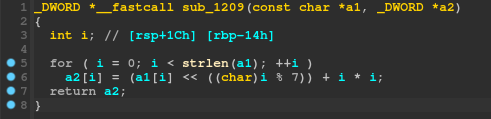
Ah, much better. Each number of the a2 array is set to the corresponding number of the a1 array, shifted left by i % 7 and then has i * i added to it. However, recall that a1 is indeed our input password. Thus, what actually happens here, is each byte of our input password is manipulated with that formula, then put into the a2 array, which is then compared with the global byte array.
So, if we want our password to be equal to the byte array after this formula is ran on it, we can just do the reverse, and run the reversed formula on the global byte array instead. Let's do that in python:
=
=
= >>
+=
I extracted all the bytes from the global array, then for each one of them, I apply the reversed formula:
- Subtract
i * ias it's the last that's added in the normal formula - Shift right instead of left, to bring to original position
And... voila!
